
Persistent Agents for the Built Environment
A practical guide to persistent AI agents: how they preserve obligations across time, where they can help the built environment, and the boundaries that keep people accountable.
WATCH OR LISTEN
A 75-second visual story
Follow one revision from fragmented knowledge to persistent, governed responsibility.
A project does not need another machine that can speak. It needs a system that can remember what matters, notice what has changed and return when a decision is due.

Conceptual illustration. It represents a governed agent workflow, not an autonomous site or a deployed product screen.
06:17, Monday
Before the first coordination meeting, a revised structural model arrives.
The revision is technically small: an opening has moved. Its consequences are not. The mechanical route may clash. The quantity take-off may be stale. A fabrication package may already have been released. A subcontractor's method statement refers to the previous geometry. The programme contains an activity whose float now matters. Somewhere in last month's meeting minutes is the reason the opening was moved in the first place.
Nobody on the project is entirely ignorant. The architect knows the revision. The structural engineer knows its intent. The planner knows the affected activity. The commercial team knows the exposure. The site team knows what has already happened. Yet the project, as a whole, does not know.
This is one of the defining problems of the built environment. Knowledge exists, but continuity breaks between documents, models, systems, organisations, shifts and phases. We compensate with meetings, inboxes, spreadsheets, messaging groups and experienced people who carry an extraordinary amount of context in their heads.
Now imagine a different kind of digital colleague. It does not sit awake inventing work. It waits. When the revision arrives, it recognises the event, restores the relevant project state, traces the affected relationships, gathers the current evidence and prepares a bounded impact brief. It does not approve the design or instruct the site. It presents what changed, what may be affected, what remains uncertain, who owns the next decision and when the matter should be checked again.
After the meeting, it records the approved decision and its basis. Three weeks later, when the fabrication status changes, it reopens the same obligation with new evidence rather than beginning again from an empty chat box.
That is the promise of a persistent agent.
Projects rarely fail because nobody knew anything. They fail because what was known did not arrive where the next decision was made.
This article explains what persistent agents are, how they differ from familiar assistants, why the built environment has a distinctive need for continuity, and what responsible adoption would require. It closes with the research questions BIMSAARTHI is exploring across projects, cities and land.
1. What is a persistent agent?
A persistent agent is an AI-enabled software system given a bounded responsibility across time. It can pause and resume, preserve structured state, respond to events, use authorised tools, retrieve relevant memory, request human decisions and reuse reviewed outcomes.
The word persistent does not mean that a large language model runs continuously. That would be expensive, unreliable and unnecessary. The model is invoked only while reasoning work is active. Persistence lives in the surrounding system: durable identity, checkpoints, schedules, event subscriptions, knowledge, evidence, permissions, budgets and an audit trail.
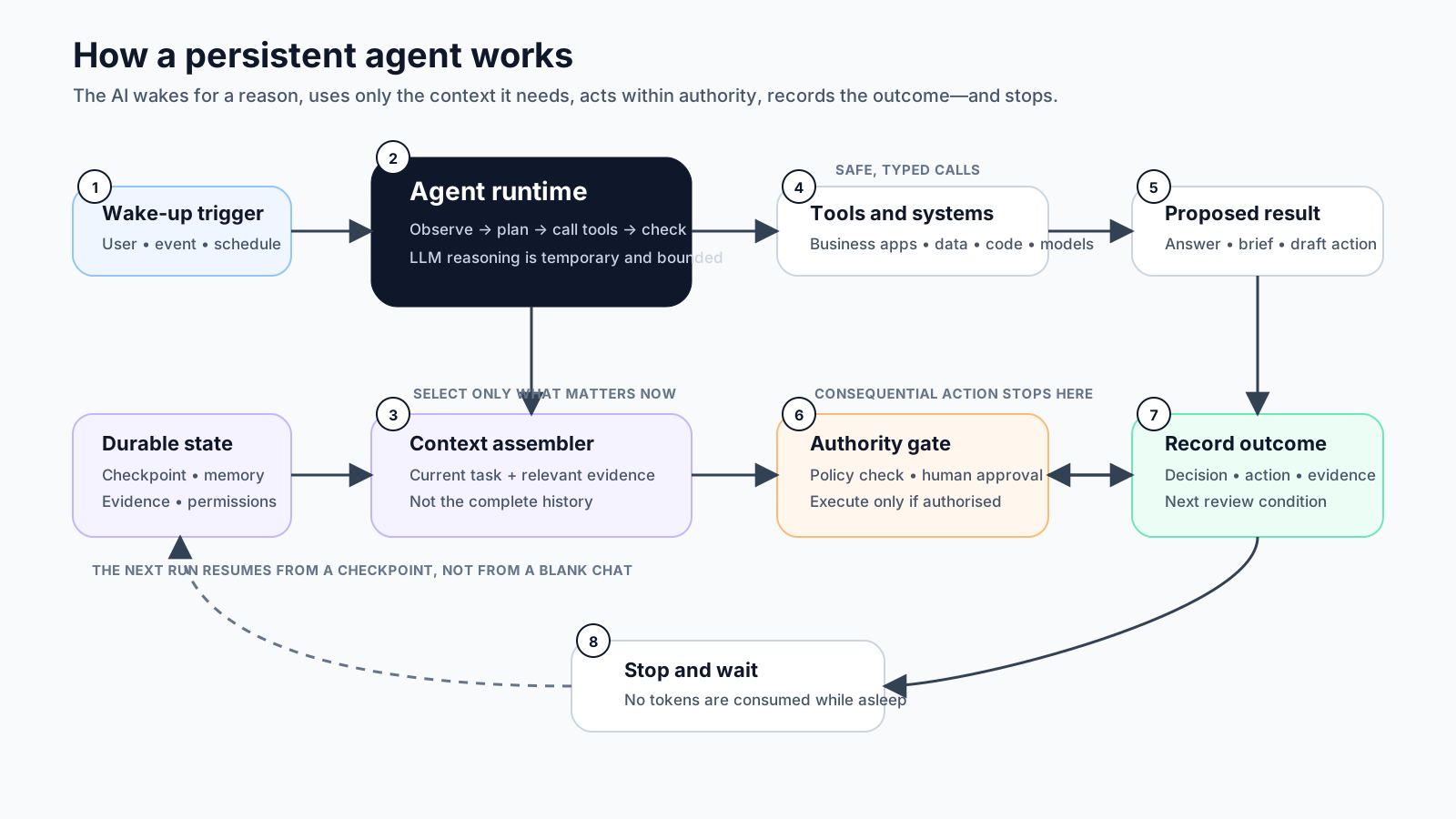
A general persistent-agent architecture. Model reasoning activates when needed; durable state, evidence and application policy survive between runs.
The agent can therefore answer six questions each time it wakes:
- What changed? A drawing, model, sensor reading, approval, delivery, forecast or deadline.
- Why am I involved? The event intersects with a responsibility assigned to this agent.
- What was already known? The last accepted state, open obligations, prior decisions and unresolved uncertainty.
- What evidence is valid now? Current, permissioned and versioned information for this task.
- What may I do? Observe, analyse, recommend, prepare a transaction—or, in narrowly authorised cases, execute it.
- When should this return? On a dependency change, a new event, a scheduled review or a human response.
This is closer to a continuing role than a continuing conversation.
Persistence is not endless thinking. It is reliable return.
2. What makes it different?

Conceptual comparison. The persistent path is selective and governed; it does not mean remembering everything forever.
The industry is already crowded with digital terms. The distinctions matter because each system carries a different responsibility.
| System | Its centre of gravity | What happens over time | What it is not designed to own |
|---|---|---|---|
| Chatbot | A conversation and an immediate answer | Usually relies on the present transcript | A continuing project obligation |
| Copilot | Assistance while a person is working | Remains useful when the user is present | Independent monitoring between sessions |
| Retrieval-augmented generation (RAG) assistant | Finding relevant passages and generating an answer | Retrieval can be repeated, but responsibility does not necessarily persist | Workflow state, deadlines or action authority |
| Workflow automation | A predefined sequence of rules and integrations | Persists exactly as its process definition allows | Interpreting novel, ambiguous situations |
| Robotic process automation (RPA) bot | Repeating interface-level tasks | Replays scripted actions | Semantic understanding of project context |
| Digital twin | A digital representation of an asset, process or system | Maintains or analyses state across a lifecycle | Responsibility for deciding which workflow must now occur |
| Persistent agent | A bounded responsibility connected to events, evidence and tools | Resumes from durable state and follows an obligation towards closure | Unlimited autonomy or final professional accountability |
These categories can be combined. A persistent agent may converse through a chatbot, retrieve evidence through RAG, inspect a digital twin, call a deterministic workflow and then ask a person for approval. The difference is orchestration around a continuing objective.
Consider the instruction: “Watch design changes that may affect released work packages.” A chatbot can explain how to perform that task. A copilot can help while a coordinator reviews a revision. A workflow can notify everyone whenever any file changes. A persistent agent can retain the specific scope, wake on a revision event, compare versions, trace affected packages, exclude irrelevant changes, record uncertainty, prepare the review and revisit it when an owner responds.
Its defining unit is not the message. It is the obligation.
3. How a persistent agent works
A robust persistent agent is not “an LLM with a very long prompt.” It is a governed application in which language models are replaceable reasoning components.
1. Triggers — what wakes it
Events may come from a common data environment, BIM platform, schedule, business system, sensor, field form, weather feed, email gateway or timer. Each trigger carries a compact set of structured details: identity, project or tenant, timestamp, source version and scope. The system must also recognise duplicate events so that the same change does not create repeated work.
2. Workflow state — where it was
The agent stores its present step, unresolved questions, deadlines, dependencies, budget and approval state outside the model. A checkpoint allows a later run—or a different model—to continue without replaying an entire history.
3. Knowledge and evidence — what the world means
Documents are essential, but built-environment decisions depend on relationships: this element belongs to that system; this work package uses that drawing; this activity precedes that inspection; this asset serves these spaces; this field lies within this watershed.
A knowledge graph makes those relations queryable. Temporal validity records when a fact applied. Provenance records where it came from. Authority records who may rely on or change it. The graph does not replace drawings, specifications, images or simulation files; it connects their identities and meaning.
Open standards matter here. IFC is a vendor-neutral, international standard for digital descriptions of built assets across their lifecycle, giving agents a more stable semantic surface than screen scraping proprietary interfaces. (buildingSMART IFC mandate)
4. Context assembly — what the model sees now
The context window is a workbench, not a warehouse. The system retrieves the smallest useful set of connected facts, evidence excerpts, policy and current checkpoint for the task. Stable instructions remain stable; changing project facts are fetched at the time of use.
Anthropic describes this broader discipline as context engineering: curating the entire state presented to a model, not merely writing a clever prompt. Its work on long-running agents also emphasises external artefacts and clear handovers across context windows. (Context engineering, Long-running agents)
5. Tools and business systems — what it can actually do
Calculations, database queries, clash tests, schedule analysis, GIS operations, simulations and business transactions belong in typed tools. Deterministic code should handle arithmetic and rules where possible. Language models should interpret ambiguity, construct plans and explain results—not impersonate a calculator, database or structural analysis package.
6. Policy and authority — where it must stop
Every agent needs an application-enforced authority boundary. A site-safety agent may identify evidence gaps and draft a review; it must not silently certify a method statement. A commercial agent may prepare a variation assessment; it must not commit funds without delegated authority. High-consequence steps require a named human role, an approval record and a reversible transaction wherever possible.
7. Outcome memory and observability — whether it improves
Useful memory is not a pile of transcripts. It links the trigger, retrieved evidence, recommendation, human decision, action and observed outcome. It can be corrected, aged, revoked and audited. Observability should record model and tool versions, evidence identifiers, tokens, latency, spend, approvals and failure states.
Together, these seven parts form a loop:
event → retrieve → reason → use tools → verify → seek authority → record outcome → wait
The language model participates in the loop. It is not the loop.
4. Why the built environment is a natural home
Persistent agents are relevant to many industries. The built environment has an unusually strong need because it combines long timelines, fragmented responsibility and physical consequence.
A building may pass from developer to designers, contractors, specialists, operators and occupants. An infrastructure asset may outlive the software used to design it and the institutions that commissioned it. A city decision may depend on transport, drainage, power, land use and public-service data owned by different agencies. Agricultural land connects weather, soil, crop stages, labour, water, markets and local observation.
Five characteristics make continuity difficult:
- The work is distributed. No single organisation holds the complete truth.
- The evidence is heterogeneous. Models, drawings, photos, contracts, sensor streams and human observations all matter.
- The truth changes. Versions, site conditions, prices, programmes and regulations evolve.
- The consequences propagate. One change can cross technical, commercial, safety and operational boundaries.
- The accountability remains human. Professional judgement and statutory roles cannot be dissolved into a model output.
A digital twin helps represent an asset or system. A knowledge graph connects meaning and dependencies. A persistent agent adds continuity of attention: it notices when the representation changes, determines which obligations may be affected and assembles the next decision.
The twin describes the world. The graph explains its relationships. The agent carries responsibility through change.
This direction is already visible in research. Built-environment knowledge graphs have been proposed as a shared layer across fragmented data. Recent studies explore graph-grounded agents for native IFC reasoning, contract review, MEP constructability, safety assessment and structural design. These are promising research results—not evidence that construction autonomy is solved. Several studies report strong task-specific performance, but their systems, datasets and expert oversight differ, and each must be validated in the conditions where it will be used. (Built Environment Knowledge Graph, IFC Agent, Contract knowledge graph, MEP constructability study, Safety assessment study)
What is usable now, and what is still emerging?
Many components are usable now: event queues, workflow engines, knowledge graphs, BIM and GIS APIs, retrieval systems, model tool-calling, checkpoints, access controls and human approval gates. Organisations can combine them today for narrow, read-only or recommendation-led responsibilities.
What remains emerging is dependable end-to-end agency across companies, long time horizons and high-consequence physical work. Interoperability is uneven. Project data is often incomplete. Benchmarks rarely reproduce the contractual, organisational and field conditions of a live programme. The near-term opportunity is therefore not a universal autonomous project manager. It is a portfolio of bounded agents whose evidence, authority and outcomes can be inspected.
5. Where persistent agents can work
The best early applications have four properties: a meaningful event, dispersed evidence, a repeatable responsibility and a clear human decision boundary.
| Lifecycle moment | Persistent responsibility | Example output | Required boundary |
|---|---|---|---|
| Brief and feasibility | Track assumptions, constraints and stakeholder decisions | Assumption register with unresolved conflicts | Sponsor validates objectives and risk appetite |
| Design coordination | Monitor revisions and dependent interfaces | Evidence-linked impact brief | Designers retain professional sign-off |
| Planning and controls | Watch progress, dependencies and forecast divergence | Exception narrative and recovery options | Planner owns baseline and accepted forecast |
| Cost and commercial | Connect change evidence to quantities, notices and entitlement dates | Draft change dossier | Authorised commercial role approves position |
| Procurement | Monitor submittals, lead times, interfaces and approvals | At-risk package list with causes | Buyers approve commitments and supplier action |
| Construction | Reconcile planned work, field observations and constraints | Readiness or constraint brief | Site management controls instruction and sequence |
| Quality | Follow an issue from observation through correction and verification | Evidence chain and overdue verification | Competent inspector accepts closure |
| Safety | Detect missing or changed risk evidence | Review request and affected-work warning | Safety leadership and responsible persons decide |
| Commissioning | Track dependencies among tests, defects, documents and training | System readiness view | Commissioning authority accepts completion |
| Handover and operations | Preserve why assets were configured and what remains open | Provenance-rich operational handover | Asset owner accepts information and residual risk |
| Infrastructure and cities | Correlate conditions across assets, services and geography | Shared incident or investment scenario | Public agencies retain command and statutory powers |
| Land and agriculture | Follow seasonal context, observations and intervention outcomes | Reviewable field advisory with evidence needs | Farmer or agronomist verifies and acts |
The critical move is from generic “AI assistance” to explicit accountability design. Each agent should have a charter:
- responsibility and scope;
- events it may observe;
- evidence it may retrieve;
- tools it may invoke;
- decisions it may recommend;
- transactions it may prepare or execute;
- conditions requiring escalation;
- budgets and time limits;
- retention, correction and audit rules.
Without a charter, persistence becomes surveillance or automation drift. With one, it can become dependable operational infrastructure.
6. The people do not disappear; their work changes shape
For a project manager, the value is not a synthetic status report. It is an earlier view of consequential divergence, with the evidence and owner attached.
For a design manager, it is not automated design approval. It is continuity across revisions, interfaces and unanswered decisions.
For a quantity surveyor or commercial manager, it is not an autonomous claim. It is a traceable connection from change event to notice, quantity, programme effect and supporting record.
For a site engineer, it is not another dashboard. It is a short, current answer to: What is ready, what is blocked, what changed and whose decision do I need?
For safety and quality professionals, it is not delegated accountability. It is a persistent evidence chain that refuses to confuse “document uploaded” with “condition verified.”
For asset operators, it is a way to inherit decisions as well as files. A maintenance team should be able to discover not only which component was installed, but why a deviation was accepted, which assumptions governed it and what later evidence confirmed the outcome.
The operating model should therefore be human-led, agent-supported. People define responsibility, approve consequential action, correct institutional memory and remain accountable. Agents make continuity cheaper and more systematic.
7. Memory, tokens and cost: the quiet engineering problem
The most expensive design is often the naïve one: send every document and the entire conversation to the strongest model on every step. It is slow, costly and can reduce quality by burying the relevant facts.
Persistent systems manage cost by changing what reaches the model:
| Technique | Practical effect |
|---|---|
| Structured triggers | A small event envelope replaces a replay of the background story. |
| Graph-scoped retrieval | Only connected entities, valid versions and permitted evidence enter context. |
| Checkpoint compaction | Decisions, open obligations and evidence IDs survive; conversational residue does not. |
| Stable prompt prefixes | Reusable policies and tool definitions can benefit from provider caching. |
| Tool-output reduction | Code filters and aggregates large logs before model interpretation. |
| Model routing | Rules and small models handle routine classification; stronger models address ambiguity. |
| Batching and parallel retrieval | Independent checks run together and repeated orchestration is reduced. |
| Hard budgets | Step, token, tool, time and spend limits stop runaway loops. |
| Outcome-based evaluation | Teams optimise cost per accepted, evidence-backed outcome—not merely cost per token. |
Long-running work also needs compaction and external checkpoints because context windows remain finite. OpenAI's agent platform describes long-running tasks and context compaction; Anthropic similarly argues for deliberate context curation and durable handover artefacts. These are complementary patterns, not permission to compress away disagreement or uncertainty. (OpenAI Agents documentation, Anthropic context engineering)
A useful cost record for every run includes input, cached-input and output tokens; model and tool latency; retrieval volume; human-review time; acceptance or correction; and the later outcome. Only then can an organisation compare a cheap answer that creates rework with a more expensive analysis that supports an accepted decision.
The target is not fewer tokens. It is less waste per trusted outcome.
8. The hard truths
Persistent agents amplify both good systems and bad ones.
Memory can institutionalise error. If a wrong relationship, obsolete drawing or mistaken decision enters long-term memory, future reasoning may become consistently wrong. Memory therefore needs source identity, temporal validity, correction and expiry.
A graph can look authoritative while remaining incomplete. Semantic structure does not guarantee truthful source data. Unknown, disputed and inferred relationships must be represented as such.
More autonomy creates more attack surface. Tool access, cross-tenant retrieval, prompt injection, malicious documents and compromised connectors can turn an assistant into an operational risk. Least privilege, isolation, validation and audit are architectural requirements.
The model may be fluent at the edge of its competence. It should abstain when evidence is insufficient, tools disagree or consequences exceed its authority.
Automation can blur responsibility. Every consequential recommendation needs an accountable owner. “The AI decided” is not a governance model.
Continuous monitoring can become workplace surveillance. Organisations must define what events are observed, for what purpose, who can inspect the record and how long it is retained.
Vendor dependence can outlive the project. Durable state, evidence identifiers, ontologies and audit records should remain portable even as models and providers change.
Agent governance research emphasises operational limits, monitoring and human review or reauthorisation for consequential systems. In the built environment, where digital decisions can reach physical work, these controls should be treated as part of engineering assurance. (Practices for Governing Agentic AI Systems)
A safe agent knows not only what it can do, but why it must stop.
9. Where BIMSAARTHI is exploring the idea

Conceptual illustration. It represents a research direction, not a deployed autonomous system.
BIMSAARTHI is investigating how persistent intelligence changes across three kinds of continuity. A construction project carries revisions, approvals and commercial obligations. A city carries dependencies among infrastructure, services, institutions and geography. Agricultural land carries observations, interventions and outcomes across a season.
| Research context | What must persist | Example change signal | Human authority |
|---|---|---|---|
| Projects | A project obligation and its evidence | Revision, progress, approval, cost or schedule event | Project and professional roles |
| Cities | An urban dependency and institutional decision | Infrastructure, environmental or service event | Agencies, operators and public authorities |
| Land and agriculture | A field, crop and seasonal episode | Observation, weather, intervention or crop-stage change | Farmer, adviser and domain specialist |
The technical foundation may share event-driven execution, knowledge graphs, spatial and temporal context, provenance, deterministic tools, permissioned model context, human approval and outcome memory. The domain model, evidence and decision rights must remain specific to each setting.
These are research and product directions—not claims of completed deployment. The useful question is not whether one general agent can operate every domain. It is whether a bounded system can preserve the right context, return at the right moment and support the accountable person without crossing its authority.
10. A responsible path from assistant to institution
The sensible roadmap is progressive. Trust should be earned with evidence before authority expands.
| Phase | Capability | Evidence required before advancing |
|---|---|---|
| 0. Define the charter | Responsibility, sources, tools, authority, escalation and budget | Domain-owner and governance approval |
| 1. Observe | Read-only event detection and evidence-linked briefs | Retrieval precision, provenance completeness, false-alert rate |
| 2. Recommend | Options with uncertainty and cited evidence | Expert acceptance, correction patterns, decision usefulness |
| 3. Prepare action | Draft records, transactions or workflow changes | Approval traceability and rollback testing |
| 4. Execute narrowly | Limited, reversible action under policy | Reliability, security and exception performance in real operations |
| 5. Reuse reviewed outcomes | Retrieve relevant prior episodes and evaluate performance | Evidence that memory improves decisions without entrenching error |
| 6. Coordinate | Multiple specialist agents across bounded domains | End-to-end assurance, conflict resolution and clear accountability |
Early pilots should not ask, “Can the agent run the project?” They should ask:
- Can it detect one valuable class of change?
- Can it assemble the correct evidence more reliably than the present process?
- Can a responsible professional understand and challenge its reasoning?
- Can it preserve the decision without leaking data or authority?
- Can it return at the right moment?
- Does it reduce the total effort per accepted outcome?
That is a demanding standard—and a far more useful one than a theatrical demonstration of autonomy.
For a project organisation, the practical starting point is one recurring obligation with visible evidence, a named owner and a measurable outcome. Prove that the agent can return with the right context before granting it broader reach.
Epilogue: 16:42, three weeks later
The fabricated component has not yet left the workshop. The revised opening can still be accommodated, but only if the decision reaches the supplier today.
The agent reopens the obligation. It does not announce that it has solved the project. It shows the accepted design decision, the evidence used, the condition that has now changed, the remaining window and the responsible people. The commercial manager sees the notice implication. The planner sees the protected activity. The engineer sees the precise technical question. A human decision is made with enough time to matter.
The most valuable act was not generating a paragraph. It was preserving the thread between one moment and the next.
Persistent agents may eventually become part of the invisible operating fabric of projects, assets, cities and landscapes. Their success will not be measured by how human they sound. It will be measured by whether they help real people make better, earlier and more accountable decisions—without forgetting the evidence, exceeding their authority or losing the reason a decision existed.
The future is not a project run by AI. It is a project that no longer forgets itself.
Continue the conversation
Persistent agents sit at the intersection of several community themes:
- Engineering Intelligence — evidence, reasoning and accountable decisions.
- Knowledge Graphs — relationships, provenance and shared meaning.
- Digital Twins — state and change across physical systems.
- Open Standards & Systems — portable information and interoperable tools.
A useful starting question for your field is: Which recurring obligation is important enough to remember, bounded enough to inspect and consequential enough to keep under human authority?
Sources
- https://developers.openai.com/api/docs/guides/agents
- https://www.anthropic.com/engineering/effective-context-engineering-for-ai-agents
- https://www.anthropic.com/engineering/effective-harnesses-for-long-running-agents
- https://www.buildingsmart.org/wp-content/uploads/2024/10/IFC-Mandate-Final-1.pdf
- https://arxiv.org/abs/2211.02864
- https://arxiv.org/abs/2309.12132
- https://arxiv.org/abs/2408.08054
- https://cdn.openai.com/papers/practices-for-governing-agentic-ai-systems.pdf
KEEP THE IDEA MOVING
What does this look like in your field?
Explore questions and perspectives in Engineering Intelligence.