
3D Gaussian Splatting: From Photos to Explorable Spaces
A visual introduction to 3D Gaussian Splatting, its potential for the built environment, and what we learned from our first phone-to-3D experiment.
WATCH OR LISTEN
A 75-second visual story
Follow one capture from promise to failure, result and the engineering boundary.
A visual introduction, from the breakthrough to our first real capture.
A site photograph shows a doorway and an unfinished wall. But which room is it? What sits behind the camera? What changed since the previous visit?
3D Gaussian Splatting (3DGS) offers another way to revisit a captured place: move through a reconstructed scene instead of watching a fixed video.
This article introduces the technology, shows where it may help the built environment and shares what happened when we tried it with an iPhone.
1. The idea: a scene made of soft 3D shapes
Imagine a room represented by thousands—or millions—of soft, coloured ellipsoids. Each has a position, size, orientation, opacity and appearance. Projected onto the screen, their overlapping footprints form a view of the scene.
These footprints are called splats. The system fits their parameters to photographs, then renders different viewpoints. This is novel-view synthesis: showing a view the camera did not directly record. How Splatfacto represents a scene
It is not a language model imagining a room. Nor does it automatically understand walls, defects or construction rules.
| What you need | Relevant representation |
|---|---|
| Original visual evidence | Photographs and video |
| Sampled spatial positions | Point cloud |
| Connected surfaces | Mesh |
| Appearance-rich exploration | Gaussian splat scene |
| Building elements, properties and relationships | Building Information Model (BIM) |
A realistic view is not proof of accurate dimensions. These representations can complement one another; none automatically supplies all the others.
2. The evolution—in one picture
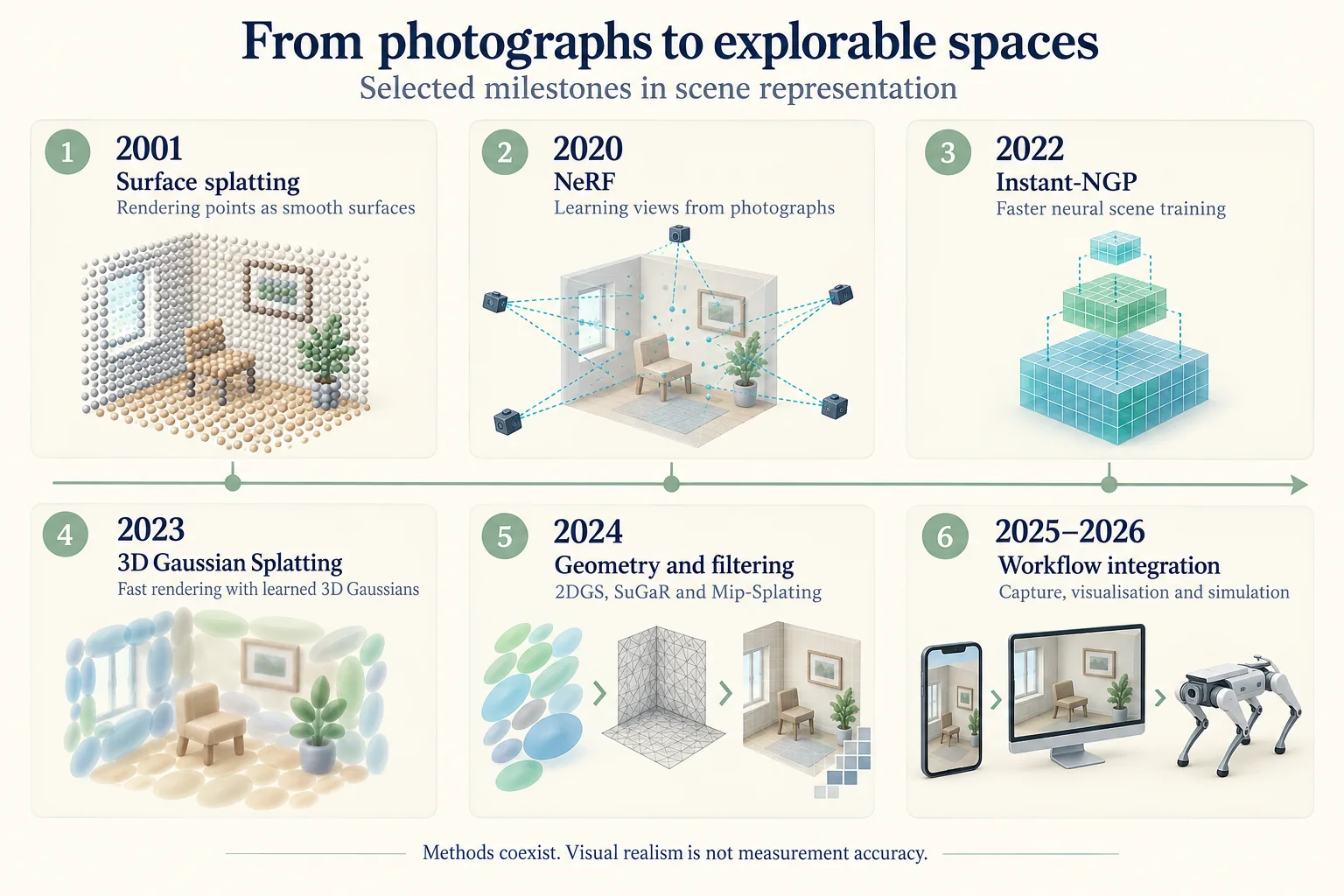
AI-generated educational illustration—not scan evidence. Methods coexist. The 2024 grouping uses conference years; SuGaR and Mip-Splatting had 2023 preprints. Mobile splat capture was already available in 2024.
The turning point in 2023 was not simply converting photographs into 3D. It was combining a directly stored Gaussian representation, adaptive optimisation and fast rendering to make richly reconstructed scenes interactive. Original 3DGS work
Explore the six milestones and original sources
- 2001 — Surface Splatting: smooth rendering from point samples, an ancestor rather than modern learned 3DGS. Zwicker et al.
- 2020 — NeRF: a neural network learns scene density and view-dependent colour from photographs. Mildenhall et al.
- 2022 — Instant-NGP: multiresolution hash encoding accelerates neural scene fitting. Müller et al.
- 2023 — 3DGS: Kerbl, Kopanas, Leimkühler and Drettakis demonstrate high-quality real-time view synthesis on their evaluated scenes. Author project
- 2024 — Geometry and filtering: Mip-Splatting tackles sampling artefacts; SuGaR explores surface alignment and meshes; 2DGS favours surface geometry.
- 2025–2026 — Wider integration: architectural rendering, GIS and simulation incorporate Gaussian representations. The applications section gives concrete examples.
3. From camera footage to an explorable scene
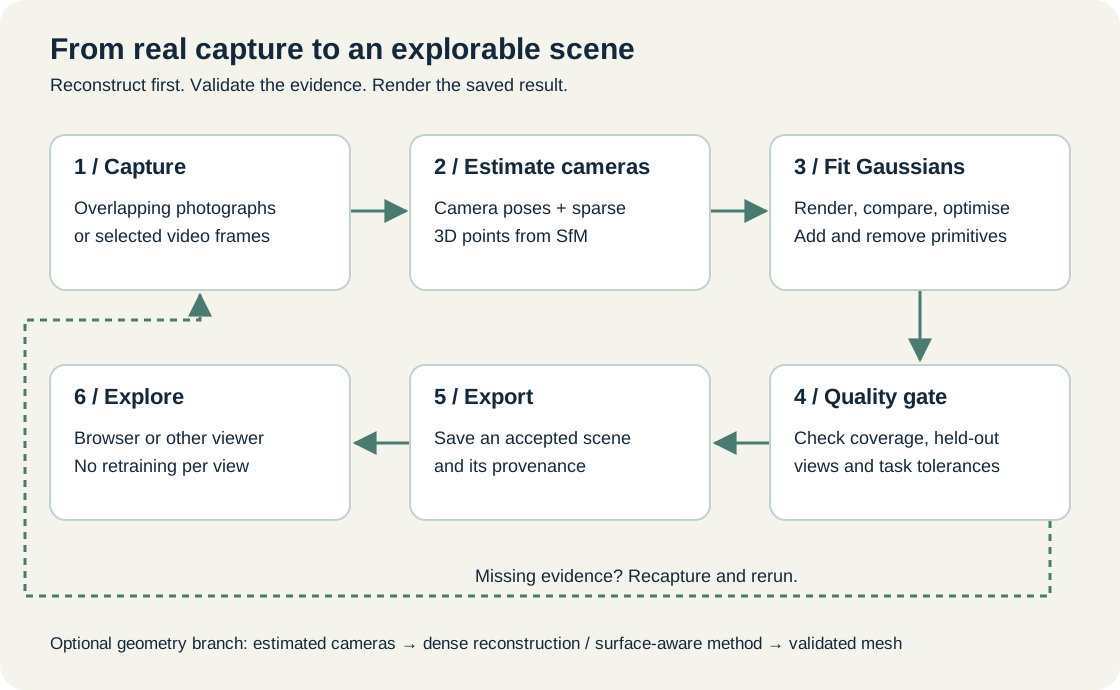
Reconstruction fits a scene; viewing renders the saved result. The quality gate is our recommended application practice.
Capture → estimate cameras → fit Gaussians → validate → view.
Overlapping photographs let Structure from Motion (SfM) estimate camera positions and orientations, called poses, plus sparse 3D points. The original 3DGS workflow uses these points to initialise Gaussians, then adjusts them by comparing rendered images with photographs. COLMAP tutorial · Original method
Watch the capture stage
Our actual phone screen recording · 2× speed · approximately 30 seconds · silent. Feature markers and guidance help the operator, but do not prove complete coverage.
The camera must move between positions, not only turn in one spot. Blurred frames, weak texture or insufficient overlap can prevent camera registration. If evidence is missing, the useful response is often recapture, not more training.
4. Where the technology is already moving
Architecture, mapping, storytelling and simulation are already bringing Gaussian scenes into practical workflows.
| Sector | Example and demonstrated use |
|---|---|
| Architecture | Chaos/V-Ray demonstrates a captured Hanoi environment as context for a design scene. |
| Film | The June July production proof of concept brings a captured building into an LED-wall workflow using a specialised relightable pipeline. Ordinary splats do not automatically support this. |
| Museums and education | Nydia at the Saint Louis Art Museum combines splats, spatial anchoring and storytelling. Its historical environment is designed content, not a scan of ancient Pompeii. |
| Mapping and infrastructure | ArcGIS Pro supports splat layers alongside other spatial data, with documented analysis limitations. |
| Simulation | NVIDIA NuRec uses reconstructed scenes in autonomous-vehicle simulation workflows. Appearance is only one part of a physical simulation. |
Property walkthroughs and heritage documentation are related opportunities. These examples show growing practical interest; they do not make every splat a measured engineering model.
5. What it could add to construction
For a remote reviewer, the immediate benefit is spatial context: recognise the room, inspect nearby surfaces and locate the evidence behind a comment.
We see three useful levels to explore:
- See and annotate: explore a captured area; attach issues, photographs and comments to locations.
- Compare visits: align dated captures before reviewing progress. Missing capture coverage means unobserved, not unfinished.
- Measure and compare with design: validate scale, geometry and alignment before using a mesh or BIM overlay for decisions.
Watch the experimental spatial preview
Our actual phone screen recording · 2× speed · approximately 14 seconds · silent. Sparse points and a camera path provide provisional feedback. This is not a mesh, surveyed floor plan or complete coverage map.
Hidden work, material properties and fine defects still cannot be judged from scene appearance alone.
6. Our first result—and its missing pieces
We tested real office footage from an iPhone 13 mini, using COLMAP and Nerfstudio's Splatfacto on a rented NVIDIA A40.
| Input | Connected reconstruction | Export |
|---|---|---|
| 99 sampled frames from an approximately 33-second take | 65 frames registered; first 34 absent | 224,069 Gaussians after 4,000 training steps |
Explore the result
Our actual viewer screen recording · 2× speed · approximately 10 seconds. Moving away from well-supported viewpoints exposes holes and stretched regions. Playback is accelerated—not a rendering-speed benchmark.
The room is recognisable, but the reconstruction is partial. We did not validate a whole-room scan, mesh, physical dimensions or construction quality.
A separate reference with supplied poses helped check training. Another low-resolution sample failed camera registration and was not trained. The lesson: a successful training pipeline cannot recover observations that were never captured reliably.
Sample work: BIMSAARTHI experiments EXP-004 and EXP-005, 3 October 2026. The recordings show the workflow and result.
7. What we would improve next
Our priority is capture quality, not simply a larger GPU.
- Keep a consistent lens, move slowly and maintain overlapping views.
- Make recording stops and tracking losses unmistakable.
- Revisit missed areas from different positions.
- Validate reference dimensions before claiming measurement accuracy.
Landscape is a practical next-test preference, not a proven advantage: our partial result used portrait footage. A 360 camera may ease aiming, but does not automatically measure depth.
For future affordable hardware, we will test whether stereo cameras, inertial sensors or depth sensing solve a measured failure. Calibration, synchronisation and field usability matter as much as the component list.
8. Learn more and try it
Start with 3DGS for the core method. Mip-Splatting addresses viewing-scale artefacts, while SuGaR and 2DGS explore geometry.
Open-source tools by task
| Task | GitHub starting points |
|---|---|
| Understand the reference method | Original 3DGS |
| Estimate cameras | COLMAP |
| Train and evaluate | Nerfstudio, gsplat |
| View in a browser | Spark |
| Investigate surfaces and meshes | 2DGS, SuGaR, OpenMVS |
| Explore browser tracking | AlvaAR—not a 3DGS trainer |
Check licences, dependencies, hardware and dataset permissions before reuse. This is a learning path, not a ranking of universally “best” tools.
9. The takeaway
3D Gaussian Splatting turns photographs into a place someone else can explore. For construction, that can make remote evidence easier to understand.
Trust still depends on what was captured, what is missing and what was independently checked. Our first experiment showed both the promise and the gaps.
Continue the conversation
This perspective belongs primarily to Computer Vision & Sensing. It also connects to AR/VR & Spatial Computing through explorable scenes and to Digital Twins when capture evidence is linked to asset identity, time and decisions.
Which site decision would better spatial context help you make—and what evidence would you need before trusting it?
Disclosure: one AI-generated timeline, one authored architecture diagram and three BIMSAARTHI experiment recordings. Videos are shown at 2× speed without audio. Sources checked on 3 October 2026. This work remains at the research and experimentation stage.
Sources
- https://repo-sam.inria.fr/fungraph/3d-gaussian-splatting/
- https://docs.nerf.studio/nerfology/methods/splat.html
- https://www.merl.com/publications/TR2001-20
- https://www.matthewtancik.com/nerf
- https://nvlabs.github.io/instant-ngp/
- https://niujinshuchong.github.io/mip-splatting/
- https://arxiv.org/abs/2311.12775
- https://surfsplatting.github.io/
- https://colmap.github.io/tutorial.html
- https://www.chaos.com/blog/gaussian-splats-v-ray-sketchup
- https://info.nianticspatial.com/blog/behind-the-build-telling-nydias-story-in-webar
- https://doc.esri.com/en/arcgis-pro/latest/help/mapping/layer-properties/work-with-gaussian-splat-layers.html
- https://docs.nvidia.com/nurec/best-practices/scaling-neural-reconstruction.html
KEEP THE IDEA MOVING
What does this look like in your field?
Explore questions and perspectives in Computer Vision & Sensing.